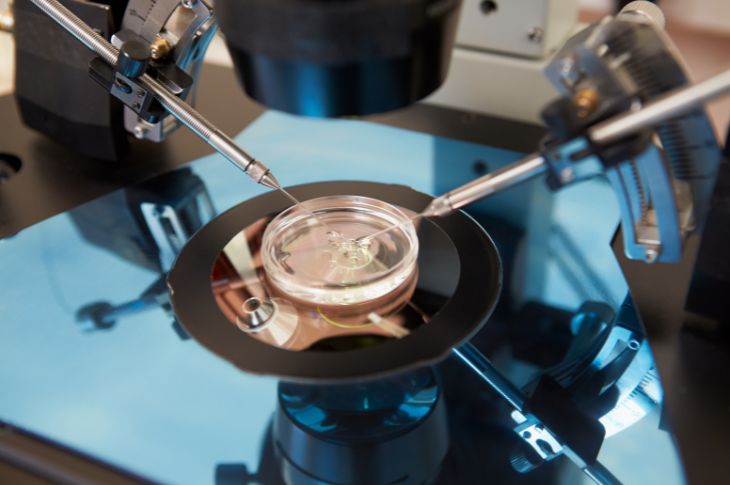
IVF and ICSI: two routes to fertilization.
After retrieval, embryologists assess the oocytes and prepare the sperm sample. In conventional IVF, eggs are incubated with prepared sperm. In ICSI, a single sperm is injected into a mature oocyte using micromanipulation equipment.
ICSI is often considered when sperm factors or previous fertilization history make it appropriate. It assists fertilization; it does not correct an egg’s chromosome abnormalities or guarantee embryo development.
Fertilization is assessed after insemination. Normally fertilized eggs are then cultured and monitored as they divide. Not every retrieved egg is mature, not every mature egg fertilizes, and not every embryo reaches the blastocyst stage.
Time-lapse culture: development over time.
A blastocyst is an embryo with a fluid-filled cavity, an inner cell mass and an outer cell layer called the trophectoderm. Embryos commonly reach this stage around days 5–7, although individual development varies.
ENNE identifies Esco time-lapse incubators among its systems. The incubator captures serial images so embryologists can review the timing and pattern of cell divisions while maintaining the controlled culture environment.
Time-lapse adds developmental information to conventional morphology. It is not a chromosome test, and an attractive developmental pattern is not a guarantee of implantation.
- Controlled culture conditions support embryo development.
- Repeated imaging records changes that a single observation might miss.
- Embryologists interpret development alongside the patient’s clinical context.
Three AI tools. Different clinical questions.
AI-based assessment uses patterns learned from image data to support laboratory interpretation. It provides an additional assessment; it does not replace clinical judgment.
| System | Role described by the clinic | How to interpret it |
|---|---|---|
| Claire | AI-supported embryo assessment with Esco time-lapse imaging. | An assessment aid, not a definitive genetic diagnosis. |
| Violet · Future Fertility | Image-based oocyte assessment for egg-freezing counseling. | Additional information about stored eggs; future live birth is not assured. |
| Magenta · Future Fertility | Image-based oocyte assessment in IVF. | Supports understanding of oocyte potential alongside actual fertilization and development. |
Sperm selection and ZyMōt.
Sperm preparation aims to obtain a suitable sample for fertilization. Conventional laboratory methods and microfluidic selection are different approaches to this task.
ZyMōt uses sperm movement through a microfluidic device to separate a motile fraction. The group describes its use as an additional selection option. Whether it adds value depends on the sample, treatment method and clinical history.
Better laboratory measures do not automatically establish a higher live-birth rate for every patient. The proposed method and any additional fee should be discussed as part of the plan.
PGT-A, PGT-M and PGT-SR are different tests.
PGT-A screens chromosome number; PGT-M targets a specific familial single-gene condition; PGT-SR addresses chromosome rearrangements. The indication and test design are agreed with the clinical and genetics teams.
Testing usually samples trophectoderm cells from a blastocyst. The embryo is generally vitrified while the result is processed, so transfer occurs later.
A biopsy samples only some cells. Mosaic, inconclusive and other complex results require careful interpretation. PGT does not test for every disease or replace recommended prenatal screening and diagnostic discussions.
| Test | Question addressed |
|---|---|
| PGT-A · Aneuploidy | Does the sample show the expected number of chromosomes? |
| PGT-M · Monogenic conditions | Does the sample carry a specific familial single-gene condition? This requires case-specific preparation. |
| PGT-SR · Structural rearrangements | Does the sample show an unbalanced chromosome rearrangement relevant to a known parental finding? |
Vitrification and frozen embryo transfer.
Vitrification uses cryoprotectants and rapid cooling to preserve eggs or embryos while limiting ice-crystal formation. Sperm cryopreservation uses protocols suited to the sample and its intended future use.
Stored material must remain identifiable and traceable. Consent, storage terms and decisions about future use form part of the treatment record.
For a frozen embryo transfer, the physician plans the timing of endometrial preparation and embryo warming. Survival after warming, implantation and live birth are separate outcomes; no freezing method guarantees all three.
IVM: maturation takes place in the laboratory.
In vitro maturation moves a key step—oocyte maturation—from the ovary into a specialized laboratory setting. Immature oocytes are retrieved and cultured before fertilization.
It differs from conventional IVF, where stimulation aims to obtain mature oocytes at retrieval. IVM may reduce stimulation exposure in selected cases, but requires a specific clinical and laboratory assessment.
Quality is also the work you do not see.
Laboratory care includes identity checks, documented handling, equipment monitoring, controlled storage and communication with the medical team. ANVISA’s reproductive-cell and embryo framework sets technical and sanitary requirements for Brazilian centers.
Your physician confirms which technologies are available at the chosen location, which are recommended for you and which are specified in your treatment budget. A longer list of add-ons is not automatically a better treatment.
São Paulo: treatments and laboratory systems · Embryology, services and team · Clinical history · ZyMōt: the clinic's explanation